
It is 2 AM. You hum a melody into your phone, mumble some half-formed lyrics, and tap save. The next morning you upload it to your transcription tool. The result reads like a drunk text message. "Hold me closer" became "old me closer." "Tiny dancer" became "tie knee dancer." The idea you captured, the one that felt like gold six hours ago, is now buried under garbled text.
You blame the transcription tool. But the problem started earlier. It started with the microphone.
Most songwriters and voice-over artists record in untreated bedrooms, living rooms with hardwood floors, or home offices with computer fans humming two feet away. They buy whatever microphone was on sale, plug it in, and assume the transcription engine will figure out the rest. It does not.
So here is the question: condenser or dynamic? If you are a musician capturing song ideas, lyrics, or voice-over takes in a real-world room rather than a treated studio, which microphone type actually sends the cleanest signal to your transcription tool?
This article answers that question with real specs, real prices, and a recommendation based on the room you actually record in.
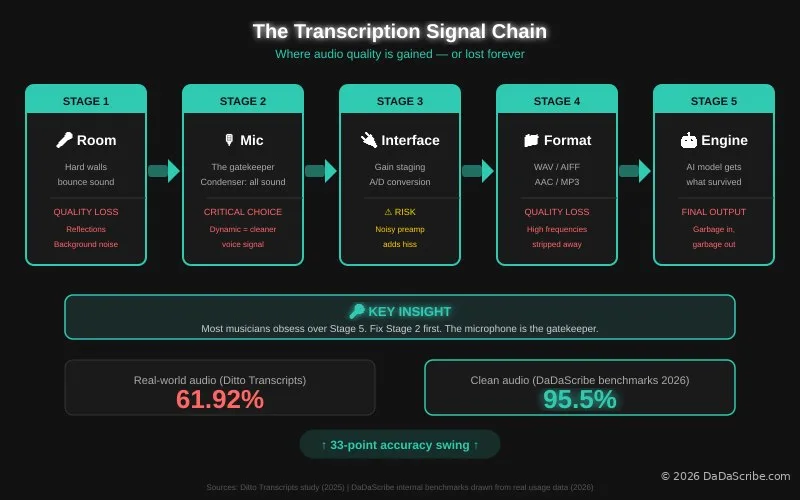
The signal chain: where transcription accuracy gets lost
Before comparing microphones, it helps to understand the full pipeline your voice travels through. Every stage either preserves information or destroys it.
Stage 1: Room acoustics
Hard walls bounce sound. Computer fans hum. Street noise bleeds through windows. Your microphone captures all of it.
Stage 2: Microphone capture
The mic decides what to keep and what to reject. This is the gatekeeper. A bad choice here poisons every stage that follows.
Stage 3: Interface and preamp
Gain staging, analog-to-digital conversion. A noisy preamp adds hiss. Too little gain and your voice is buried. Too much and it clips.
Stage 4: File format
WAV or AIFF preserves everything. Compressed formats like AAC and MP3 strip high-frequency detail. The exact detail speech recognition models rely on to distinguish "alkene" from "Al Keen."
Stage 5: Transcription engine
The AI model receives whatever survived stages 1 through 4. If the signal is muddy, the result is muddy. No transcription engine can recover information that was already lost.
A Ditto Transcripts study found that AI transcription platforms average just 61.92% accuracy on real-world audio with background noise, multiple speakers, and varied accents. DaDaScribe's own benchmarks show 95.5% accuracy on clean speech. That is a 33-percentage-point swing. A big chunk of that gap lives in the microphone.
Most musicians obsess over stage 5, which transcription tool to use, while ignoring stage 2. Fix stage 2 first.
Condenser vs dynamic: how they work and why it matters for voice
The names sound technical. The difference is mechanical. Once you understand it, the choice is not complicated.
Condenser microphones: the detail fiend
Condenser microphones use a thin, electrically charged diaphragm that responds to tiny changes in air pressure. They are extremely sensitive. They capture breath, texture, the sound of your lips parting, the hum of a refrigerator in the next room. They need 48-volt phantom power from an audio interface. Their frequency response typically extends past 20 kHz. Self-noise, the hiss the mic's own electronics produce, ranges from about 4 to 15 dBA. You can hear it during quiet vocal passages.
Dynamic microphones: the room rejector
Dynamic microphones work like a speaker in reverse. Sound waves move a heavier diaphragm attached to a coil of wire inside a magnet, which generates a tiny electrical signal. They are comparatively deaf. They ignore quiet, distant sounds. They need no external power. Plug in an XLR cable and they work. Frequency response usually rolls off around 15 kHz. Self-noise is effectively zero. The room is always louder than the mic.
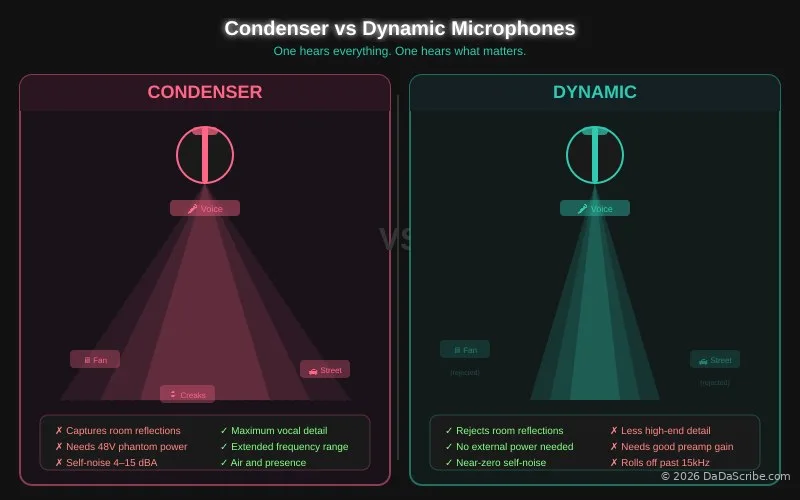
Here is the difference in one sentence: a condenser hears everything in the room. A dynamic hears the thing directly in front of it.
For transcription, this is the only distinction that matters. When you record a vocal take or a lyric idea, the transcription engine does not need the sound of your chair creaking or the car passing outside. It needs your voice, clean and isolated. A dynamic delivers that by default. A condenser delivers it only if the room cooperates.
| Factor | Condenser | Dynamic |
|---|---|---|
| Sensitivity | High, captures everything | Low, captures what is close |
| Room noise pickup | Significant | Minimal |
| Vocal detail and clarity | Excellent | Good |
| Phantom power required | Yes (48V) | No |
| Forgiveness in untreated rooms | Poor | Excellent |
The room factor: why your bedroom decides the winner
Here is the reality most buying guides skip: you do not record in a studio. You record in a bedroom with a laptop fan buzzing, a window facing a street, and walls that bounce sound like a basketball.
An untreated room creates two problems for a condenser microphone. First, early reflections. Your voice bounces off the nearest hard surface and arrives at the mic a few milliseconds later, creating a boxy, hollow tone. Second, ambient noise. HVAC systems, computer fans, keyboard clicks, distant traffic. All of it registers clearly on a condenser's sensitive diaphragm.
A dynamic microphone handles both problems through sheer indifference. It is less sensitive, so reflections arrive at a much lower level. Its cardioid polar pattern rejects sound from the sides and rear. And because dynamics reward close-mic technique, you can practically press your lips against an SM58 without overloading it, the voice-to-room ratio tilts heavily in your favor.
Try this test: record the same vocal phrase on a condenser and a dynamic in an untreated room with your computer fan running. Play both back. On the condenser, the fan will be audible. On the dynamic, if you positioned the mic with the fan in its rejection zone, the fan will be a faint whisper or absent entirely. The transcription engine receives two very different signals.
Condensers are not bad microphones. They are the wrong tool for the wrong room. Put a condenser in a treated space with acoustic panels, a rug, soft furnishings, and it rewards you with detail and air that a dynamic cannot match. But most of us do not record in treated spaces.
Head-to-head: six microphones songwriters and VO artists actually use
Three dynamics. Three condensers. Popular with musicians and voice-over artists in 2026. Every one of them is a good microphone. The question is which one is good for your room.
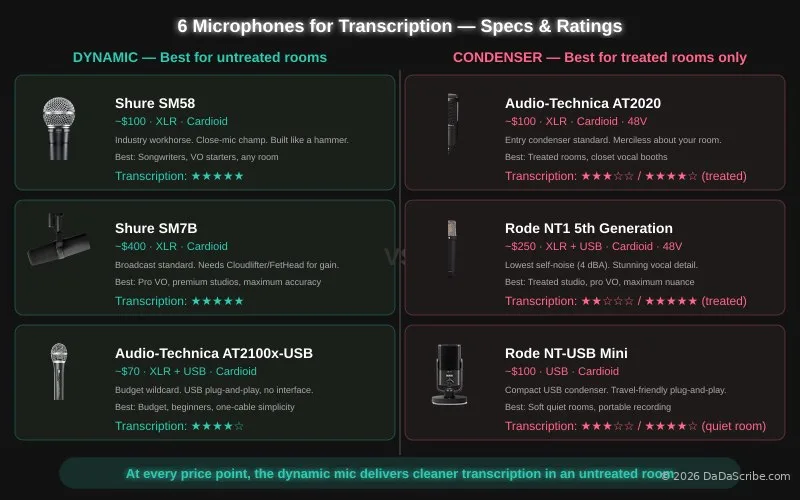
Dynamic microphones
Shure SM58 (~$100) — The industry workhorse. Built like a hammer. You can drop it, spill on it, and it will keep working. Cardioid pattern with strong off-axis rejection. Handles close-mic vocals without distorting. Needs an audio interface with decent gain. If you have ever sung into a microphone on a stage, it was probably this one. Transcription-ready? Excellent. Clean, focused vocal capture with minimal room bleed. The transcription engine gets exactly what it needs: voice, isolated, at consistent volume. Best for songwriters in untreated rooms, VO artists starting out, and anyone who wants reliable sound without fuss.
Shure SM7B (~$400) — The broadcast standard. You see this microphone in radio stations, podcast studios, and professional VO booths worldwide. Flatter frequency response than the SM58, with a built-in pop filter and internal shock mount. The catch: it needs clean gain. A lot of it. Many users add a Cloudlifter or FetHead inline preamp to boost the signal before it hits the interface. Transcription-ready? Excellent. The cleanest voice signal in the dynamic category. Minimal post-processing needed. This is the mic you want if transcription accuracy is the top priority and you have the budget for the full chain. Best for professional VO artists and songwriters who want broadcast-quality vocal capture.
Audio-Technica AT2100x-USB (~$70) — The budget wildcard. Dynamic capsule with both XLR and USB outputs. Plug it straight into your computer via USB with no audio interface needed. Or use the XLR out when you upgrade your setup later. Includes a headphone jack for zero-latency monitoring. Transcription-ready? Very good. Clean signal at an entry-level price. The USB option means fewer components in the chain, which means fewer places for noise to creep in. Best for songwriters on a budget, beginners who want one cable between them and their DAW, and anyone testing the waters before investing in a full interface setup.
Condenser microphones
Audio-Technica AT2020 (~$100) — The entry-level condenser standard. Wide, flat frequency response. Cardioid pattern. Requires 48V phantom power and an audio interface. It is the most-recommended starter condenser for good reason. It sounds more expensive than its price. But it is also merciless about your room. Transcription-ready? Good, in a treated or soft room. In an untreated bedroom, room reflections and background noise compete with your voice. The transcription engine gets a detailed but noisy signal. Best for songwriters with acoustic treatment, quiet home studios, and the classic converted walk-in closet vocal booth.
Rode NT1 5th Generation (~$250) — Exceptionally low self-noise at 4 dBA, among the quietest condensers at any price. Dual XLR and USB output. Ships with a shock mount and pop filter. Captures vocal nuance that dynamics miss entirely. Transcription-ready? Excellent, in a treated room. The low self-noise means the transcription engine hears almost no mic hiss. But the NT1 will still capture every reflection, every keyboard click, every distant siren if your room is untreated. Best for VO artists and songwriters with a properly treated space who want maximum vocal detail and the flexibility of dual XLR/USB output.
Rode NT-USB Mini (~$100) — Compact USB condenser with a built-in pop filter and magnetic base. Zero-latency headphone monitoring. One cable to your computer. No interface required. Transcription-ready? Good, if your room is quiet. The USB convenience is real. But the condenser sensitivity means it picks up keyboard clicks and room echo just as readily as it picks up your voice. Best for songwriters in soft, quiet rooms who want plug-and-play simplicity. Excellent travel companion. Less ideal for a noisy home office.
Comparison at a glance
| Mic | Type | Price | Connection | Best Room | Transcription Quality |
|---|---|---|---|---|---|
| Shure SM58 | Dynamic | ~$100 | XLR | Any room | ★★★★★ |
| Shure SM7B | Dynamic | ~$400 | XLR | Any room | ★★★★★ |
| AT2100x-USB | Dynamic | ~$70 | XLR + USB | Any room | ★★★★☆ |
| AT2020 | Condenser | ~$100 | XLR | Treated only | ★★★☆☆ / ★★★★☆ |
| Rode NT1 5th Gen | Condenser | ~$250 | XLR + USB | Treated only | ★★☆☆☆ / ★★★★★ |
| Rode NT-USB Mini | Condenser | ~$100 | USB | Quiet rooms | ★★★☆☆ / ★★★★☆ |
The pattern is consistent: at every price point, the dynamic microphone delivers a cleaner transcription-ready signal in an untreated room.
What happens when the signal reaches the transcription engine
Even with the right microphone, real-world recordings are never perfect. A chair squeaks. A page turns. A dog barks two rooms over. Here is where the transcription engine's preprocessing matters, and where your choice of tool becomes the equalizer.
DaDaScribe runs incoming audio through a four-stage pipeline before it ever reaches the speech recognition model. Stage one is noise reduction, which strips out consistent background hum. Stage two is level normalization, evening out volume spikes and quiet passages so the engine is not fighting inconsistent levels. Stage three is voice isolation, pulling the speaker forward and pushing everything else back. Stage four is a proprietary optimization pass that tunes the signal specifically for Whisper transcription. We covered the full pipeline in our guide to fixing noisy interview transcripts.
In practice, a dynamic microphone recording processed through this pipeline produces near-perfect transcription. A condenser recording in an untreated room still benefits. The pipeline compensates. But it is always playing catch-up. The cleaner the input, the less the pipeline has to fix.
For songwriters, there is an extra layer worth knowing about. DaDaScribe detects songs with 99% accuracy and routes them through a different processing path than spoken word. It recognizes that sung vocals have different dynamics, timing, and structure than speech. The output is not a wall of prose. It is formatted as structured lyrics. The one notable limitation: hard rock and metal tracks where the vocal is heavily distorted or buried deep in the mix. When the music completely swallows the words, even specialized processing cannot recover them. Nobody's pipeline can fix a vocal that was never captured clearly in the first place.
For a real look at what this processing achieves, check the DaDaScribe demos page. The song lyric extraction examples show the difference between raw audio and pipeline-processed output. Clean recordings come out near-perfect. Noisy recordings get a second chance. The ones where the vocal is already buried in the mix, well, those are the limit case.
A dynamic mic gives the transcription engine a head start. Preprocessing can clean up a condenser recording. But it is always easier to capture clean signal than to fix dirty signal.
The budget reality: dynamic wins at every tier for most home recordists
At the $70 to $100 tier, the Audio-Technica AT2100x-USB (dynamic) delivers a cleaner transcription signal than the Audio-Technica AT2020 (condenser) in a typical bedroom. No contest. The AT2020 captures more detail, and more room noise. The detail does not help if the transcription engine cannot separate it from the reflections.
At the $250 to $400 tier, the Shure SM7B (dynamic) is the voice-over gold standard for a reason. The Rode NT1 5th Gen (condenser) captures beautiful detail in a treated room. In an untreated bedroom, that detail includes chair squeaks, street noise, and the echo of your own voice bouncing off drywall. For transcription, the dynamic wins.
The most common mistake in home recording: buying a large-diaphragm condenser because it looks professional on a desk stand, then getting frustrated when transcriptions come out garbled. The microphone is not the problem. The room is.
If you can hear your room when you clap your hands, buy a dynamic. If you cannot, if your space has rugs, curtains, acoustic panels, and actual silence, buy whichever you prefer.
Frequently asked questions
Do dynamic mics have self-noise?
Effectively none. Dynamic microphones are passive, with no powered electronics, so their self-noise is effectively zero; the room is almost always louder than the mic. Condensers need 48-volt phantom power for their internal preamp, and that electronics package produces self-noise, typically 4 to 15 dBA. For transcription in an untreated room, the louder problem is usually the room itself, which is why a dynamic's room rejection often beats a condenser's lower self-noise spec.
Can I use a USB condenser mic for transcription in a regular bedroom?
You can, but expect more transcription errors from room reflections and background noise. Record close to the mic, four to six inches, and face soft furnishings like curtains or a couch to reduce reflections. Every little bit helps.
Do I need an audio interface with a dynamic microphone?
For XLR dynamics like the SM58 or SM7B, yes. They need an interface with enough clean gain to bring the signal up to line level. USB dynamics like the AT2100x-USB skip the interface entirely and plug straight into your computer. Great way to start without the extra hardware.
What about headset microphones for transcription?
Headsets keep the mic at a consistent close distance, which sounds good in theory. But most headset mics use small condenser capsules with omnidirectional patterns. They pick up everything around you. A cardioid dynamic on a stand will almost always give you a cleaner transcription signal.
Does a more expensive microphone always mean better transcription?
No. A $100 SM58 in an untreated room will produce cleaner transcriptions than a $1,000 condenser in the same room. Room acoustics matter more than price. Spend on the right type before you spend on a higher tier.
What about recording on my phone? The built-in mic sounds fine to me.
Phone mics are omnidirectional and heavily compressed. They work for capturing ideas. You should absolutely use your phone when inspiration strikes at 2 AM. But the transcription engine receives a signal that has already passed through aggressive on-device processing, leaving less speech data to work with. A proper external microphone always wins. For more on phone recording apps and how they affect transcription, read our comparison of the best voice recorder apps.
Should I treat my room or buy a new microphone first?
A dynamic microphone is cheaper and faster than acoustic treatment. Start there. If you later add rugs, curtains, and foam panels, a condenser becomes a viable upgrade. And you will already have a dynamic as your reliable backup.
The bottom line
For songwriters and voice-over artists recording in untreated rooms, which is most of us, a dynamic microphone gives your transcription tool the cleanest signal. It rejects the room, focuses on the voice, and costs less than you would expect. Condensers are excellent tools, but only when the room is right. Put the right mic in the wrong room and you are fighting physics.
The workflow that works: dynamic microphone, clean recording, preprocessing pipeline, accurate transcription. Each stage builds on the last. Fix the microphone first. Everything downstream gets easier.
Try your current recording setup through DaDaScribe's free 10-minute demo. No credit card required. Hear how your microphone sounds through a preprocessing pipeline built for real-world audio, with song detection, noise reduction, voice isolation, and format-optimized output. If the results are not where you want them, the microphone, not the transcription engine, is probably the bottleneck. And now you know which one to buy.
Comments & Questions
Please log in or sign up for a free account to leave a comment or question.
No comments yet. Be the first to ask a question!
Display more comments…