
Most people who need something transcribed still ask the same question: should I pay a human or just throw it at an AI? The answer in 2026 is more complicated than it was two years ago. AI transcription is no longer the rough first draft it used to be. But it still has gaps that matter, depending on what you're doing with the output.
We at DaDaScribe process thousands of transcriptions every month. We see where the models shine and where they fall apart. This article is a straight comparison based on real usage data, not benchmarks or marketing claims.
The State of Transcription in 2026
Transcription used to be slow, expensive, and manual. You'd send an audio file to a service, wait a few days, and get back a document with a human's name stamped on it. The quality was generally good, even though we at InfiniStrategy had experienced low-quality scores even among humans. And for sure, the turnaround was painful.
Then speech-to-text AI got good. Not just "impressive for a machine" good. Actually usable.
OpenAI's Whisper shook things up when it launched, and the open-source community has built on it relentlessly since then. Today's models handle accents, background noise, and overlapping speech far better than anything available in 2023. The gap between AI and human transcription has narrowed considerably. But it hasn't closed.
Head-to-Head: AI vs Human Transcription
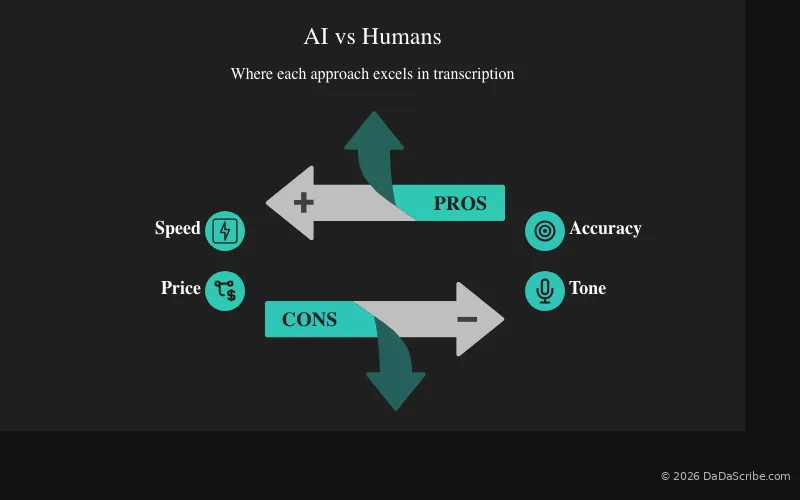
Accuracy
On single-word accuracy, current AI models beat most human transcribers. This sounds surprising if you haven't used a modern transcription tool lately, but it's consistent across the thousands of files we process. The AI doesn't get tired, doesn't mishear a word because it's distracted, and doesn't make typos.
The problem shows up around word three hundred of a long discussion. AI transcription handles individual words well. What it struggles with is maintaining logical threads across paragraphs. A human transcriber understands that when a speaker says "that policy" in minute 12, they're referring to something mentioned in minute 3. An AI model, working with context windows, sometimes loses that connection.
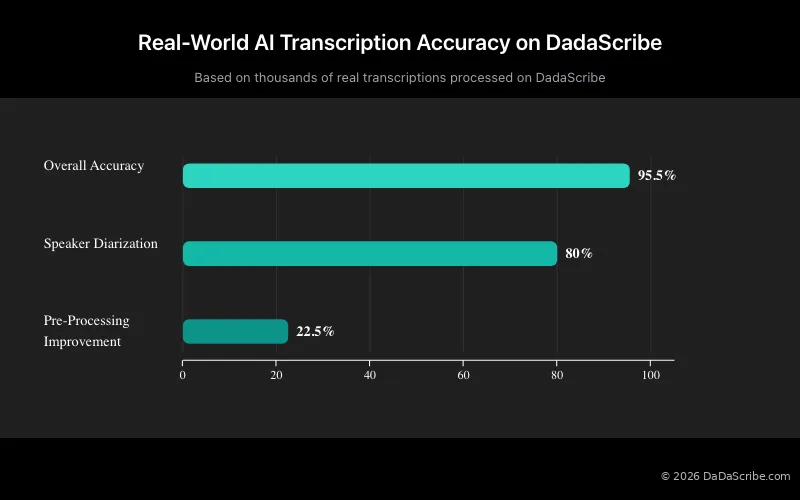
Our internal data at DaDaScribe, drawn from thousands of real transcriptions, puts average AI accuracy at 95.5% for short transcriptions of regular speech and 85% for song lyric extraction (with 100% perfect score among those clearly sung songs). Those two categories make up roughly 95% of what gets processed on the platform. That number is solid. But it's also not the whole story.
Context and Meaning
AI is better at catching every word. Humans are better at understanding what those words actually mean together.
This shows up most clearly in technical or specialized conversations. A human transcriber familiar with medical terminology, legal proceedings, or a specific industry will correctly parse jargon and acronyms that confuse an AI model. They'll also catch when a speaker contradicts themselves, uses sarcasm, or makes a subtle reference that changes the meaning of a sentence.
Context and overall meaning are still much easier to understand for a human.
AI models have improved here. They're no longer purely pattern-matching systems. But they still miss correlations that a human catches instinctively. If you're transcribing a strategy meeting where someone says "let's go with the other option" without restating what either option was, a human will go back and fill in the reference. Most AI tools won't.
Diarization (Speaker Separation)
This is where the gap is widest and most measurable.
Diarization is the task of labeling who said what. AI currently achieves around 90% accuracy on speaker separation, while a skilled human transcriber gets close to 100%. That 10-point gap matters a lot when the whole point of your transcript is knowing which executive said which part of the plan.
At DaDaScribe, we see the diarization accuracy drop even further if speakers are overlapping or if their voices are very similar. When diarization is applied to those cases, our average accuracy drops to 80%. So, be mindful of the material you are submitting. The quality and the composition of the source material are paramount.
Translation
AI translation follows a similar pattern to AI transcription. It handles the literal meaning well and gets individual words perfectly. And lately, the newest systems perfectly understand the meaning of a whole phrase or paragraph, but it is not yet 100% perfect. Where it falls short is with subtlety.
Idioms, cultural references, and tone shift across languages in ways that are hard to model. A native speaker translating from Japanese to English will capture the formality level and the implied meaning behind certain phrases. An AI translation will give you the words, but it might give you the wrong feeling. But let's be frank: humans also have problems in interpreting and translating those nuances. Try to watch a movie in its native language and then translated into another language: most of the time, the result is quite disappointing!
That said, AI translation is fast, cheap, and gets you 90% of the way there for most business and content use cases. For legal or literary work, human review is still non-negotiable.
Speed
AI wins this category by an enormous margin. A one-hour audio file gets transcribed by DaDaScribe in minutes, not hours or days. Human transcription services typically quote 24 to 48 hours for the same file. Rush jobs cost extra.
If you publish content on a schedule or need meeting notes while the conversation is still fresh, AI is the only practical choice. Speed is not a nice-to-have. For podcasters, journalists, and YouTubers, it's the difference between publishing today and publishing next week.
Cost
Human transcription costs between $0.75 and $2.00 per audio minute, depending on turnaround time, complexity, and special requirements. AI transcription on DaDaScribe's Pro plan costs $0.016 per minute. That's roughly a 50x to 100x difference.
For a one-hour weekly podcast, that's the difference between paying $45-$120 per episode for human transcription versus about $0.96 with AI. Over a year, the numbers get hard to ignore.
Consistency
Humans vary. Some transcribers are excellent. Some are mediocre. Even the same transcriber will produce different results depending on the time of day, how tired they are, and how clearly the speakers articulate.
AI transcription is consistent in a way humans aren't. Run the same file through twice, you get the same output. That predictability matters for businesses that need standardized formatting and reliability across hundreds or thousands of files.
Comparison Table
| Dimension | AI Transcription (2026) | Human Transcription |
|---|---|---|
| Single-word accuracy | 95.5% (DaDaScribe average) | 90-98% (varies by transcriber) |
| Context understanding | Limited; can miss logical threads across long audio | Strong; understands references and implications |
| Diarization | ~80% (real-world, with preprocessing) | ~100% |
| Translation subtlety | Good literal accuracy; misses cultural subtleties | Captures tone, formality, and implied meaning |
| Speed | Minutes | 24-48 hours typically |
| Cost per minute | $0.016 (DaDaScribe Pro) | $0.75 - $2.00 |
| Consistency | Identical output every time | Varies between transcribers and sessions |
| Handles accents | Good | Excellent (native speakers of the language) |
| Handles noise | Excellent, better than humans with preprocessing | Good most of the times |
What the Data Actually Says
If you read the table above and concluded that AI wins everywhere except context and diarization, you'd be mostly right. But the numbers need context.
That 95.5% average accuracy at DaDaScribe is not raw AI output. It includes the effect of our audio preprocessing pipeline: noise reduction, audio cleaning, and format prep that runs before the transcription model touches the file. Without preprocessing, the raw AI accuracy is lower. Our preprocessing adds roughly 20-25% to the accuracy figure. If you're using a generic speech-to-text API without any front-end audio work, your results will be worse than what we report here.
The 80% diarization figure is similarly honest. That's what we measure across real customer files: conference calls with five people talking over each other, podcasts recorded in untreated rooms, song recordings with instrument bleed. Lab benchmarks on clean audio will show higher numbers. Real usage rarely matches lab conditions.
We're sharing these numbers because we think the transcription market has a transparency problem. Vendors quote accuracy figures from their best-case scenarios. Customers see different results and assume the product is broken. It's usually not. It's just that real audio is messy.
Overall, humans are still more accurate when you factor in everything: context, speaker identification, formatting, and handling edge cases. The real trade-off is speed versus accuracy, plus the obvious price difference. For most use cases, speed and cost win.
When AI Wins, When Humans Win, and When You Need Both
Choose AI transcription when:
- You need the transcript fast (same day or sooner)
- You're working with clean, single-speaker audio
- Budget matters more than perfect accuracy
- You're generating subtitles or captions for content
- You need translation into multiple languages simultaneously
- You can spend 5-10 minutes proofreading the output
Choose human transcription when:
- Accuracy is the top priority (legal, medical)
- You need perfect speaker identification in multi-person recordings
- The audio quality is poor and contains heavy accents or technical jargon
- The transcript will be published as a formal record without review
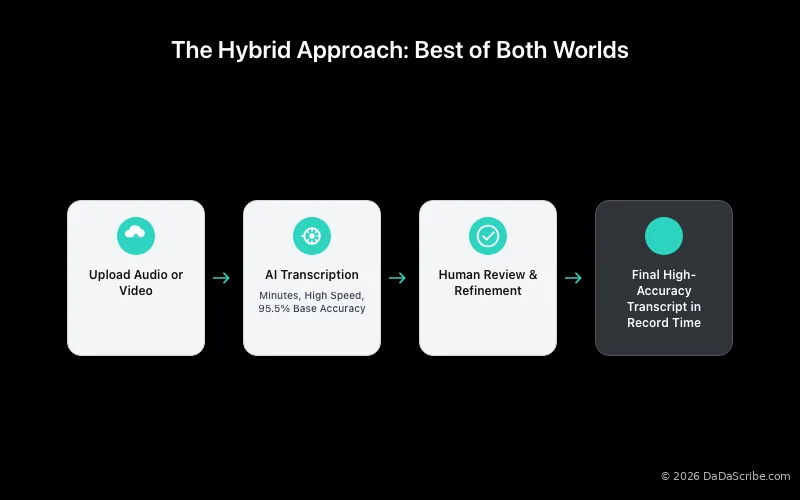
The hybrid approach (best of both):
Run AI transcription first for speed and cost, then have a human proofread and correct the output. You get 90%+ accuracy instantly and spend 10% of the time a full manual transcription would take on corrections. This is what most of our power users do, and it's the workflow we recommend to anyone who needs reliable transcripts without waiting days.
How Modern AI Tools Are Closing the Gap
The 20-25% accuracy improvement from DaDaScribe's preprocessing pipeline is not magic. It's a combination of noise reduction, dynamic range compression, and format normalization applied before the AI model ever sees the file. Clean audio in means better transcripts out.
Built-in proofreading matters too. DaDaScribe includes automatic proofreading, which always gives you strong accuracy in the final output.
Pre and post processing are the secret sauce for maximum quality and best overall results.
The feature set around the core transcription is what separates modern AI tools from older ones. Direct YouTube URL support means you paste a link and get a transcript without downloading anything. Automatic subtitle file creation (SRT) means your transcript doubles as captions. Support for 99 languages with translation into 120+ more means the tool handles localization workflows that used to require separate services.
At $0.016 per minute on the Pro plan, the price makes AI transcription accessible for use cases where human transcription was never even considered. Students transcribing lectures. Indie musicians extracting lyrics from demos. Small podcasters adding show notes for the first time. The economics changed.
Check out the DaDaScribe demos page for examples. The long-form podcast transcriptions give you a real sense of what the output looks like timestamps, speaker labels, and formatting applied automatically.
Which Transcription Method Fits Your Workflow?
Podcasters and YouTubers: AI transcription is the obvious choice. Speed matters for publishing schedules, and the accuracy on clean spoken audio is high enough that minimal proofreading gets you to publishable quality. Automatic subtitle generation is a bonus that human services rarely include.
Journalists: Use AI for first-draft speed, then review quotes and key passages manually. You need accuracy on direct quotes: those are the parts worth verifying. The rest of the interview transcript can tolerate a small error rate.
Musicians and songwriters: Lyric extraction from songs is one of the harder AI tasks because instruments bleed into the vocal track. DaDaScribe's preprocessing makes a real difference here. The 95.5% accuracy figure includes lyric extraction, so it's not just theoretical (accuracy measured in clean sung music, not in masked-voice recordings or voices overloaded with special effects). For demo recordings and rough mixes, AI transcription is more than adequate. For official liner notes or publishing, do a human review pass.
Researchers and academics: Hybrid approach. Run AI first, then review thoroughly. Research interviews often contain specialized vocabulary and subtle arguments where context matters. Budget the time for a review pass.
Businesses and corporate teams: AI transcription for internal meetings and routine documentation. Human transcription or hybrid for client-facing deliverables, legal proceedings, and board meetings where the record needs to be exact.
The Bottom Line
AI transcription in 2026 is good enough for most things. Not everything, but most things.
The accuracy gap between AI and human transcription keeps shrinking, but it's not gone. If your use case depends on perfect speaker identification or deep contextual understanding, humans still have an edge. If you need speed, scale, and a price that doesn't limit how much you transcribe, AI is already the better choice.
Most users settle in the middle: AI transcription with a quick proofreading pass. It's fast, cheap, and the output is solid.
If you want to see what 2026 AI transcription actually looks like, try the free tier on DaDaScribe. Upload a file, paste a YouTube link, or check out the demo transcriptions to see the output quality for yourself. No signup needed for the demos, and the free tier gives you enough minutes to run a real test on your own content.
About the data: The accuracy figures cited in this article come from DaDaScribe's internal analysis of thousands of real transcriptions processed on the platform, spanning regular speech, multi-speaker conversations, and song lyric extraction. These are production numbers, not lab benchmarks. "Average AI accuracy" of 95.5% reflects the mix of content types processed on DaDaScribe, where roughly 95% of transcriptions are regular speech or lyric extraction without diarization. The 80% diarization accuracy reflects real-world performance across varying audio quality levels, including noisy environments and overlapping speech.
Comments & Questions
Please log in or sign up for a free account to leave a comment or question.
Enjoy transcribing!
Display more comments…