

A journalist with a 45-minute interview and a 2-hour deadline faces a choice. Spend the next hour transcribing, or get a usable transcript in under 2 minutes. This is the daily math of modern newsrooms.
New models keep raising the bar too; here is what Gemini 3.5 Transcribe means for journalists.
We at DaDaScribe process thousands of audio files every month for reporters, researchers, and media teams. The question we hear most: "When should I trust AI and when do I need a human?" This article answers that question with real use cases, real processing data, and no marketing fluff. You will learn exactly when AI transcription is fast enough, accurate enough, and secure enough for your reporting.
Why This Data Matters
The processing times and accuracy figures in this article come from thousands of real transcriptions run through our platform, not lab tests on pristine audio. We publish them because the transcription industry has a habit of quoting best-case numbers. Real journalism does not happen in best-case conditions.
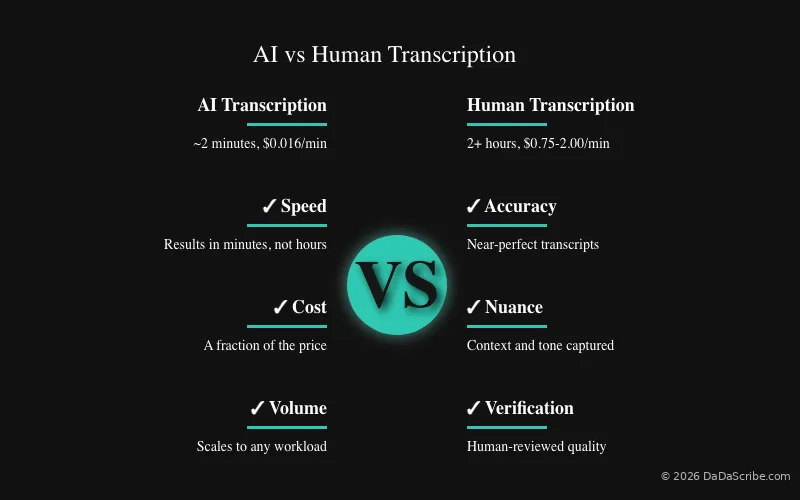
Journalism runs on deadlines. The difference between a 2-minute transcript and a 2-hour one is the difference between publishing today and publishing tomorrow. For freelance journalists and small newsrooms, cost matters just as much. Human transcription at $1.50 per minute puts a 30-minute interview at $45. At $0.016 per minute, the same interview costs $0.48 with DaDaScribe. Multiply that across 10 interviews a week and the annual difference is roughly $250 versus $23,400.
The use cases below are organized around real workflow decisions a working journalist actually makes. Each one answers a specific question you have faced or will face. If you want a broader comparison of AI versus human transcription across all dimensions, read our head-to-head analysis of AI vs human transcription.
Use Case 1: Breaking News and Tight Deadlines
The scenario: a major announcement drops at 4:30 PM. You have the audio from the press briefing. Your editor wants copy by 5:15 PM.
The math is simple. A 30-minute press conference takes 2 to 3 hours to transcribe by hand. AI does it in roughly 1 minute. You get a searchable transcript and can pull direct quotes while your competition is still rewinding audio.
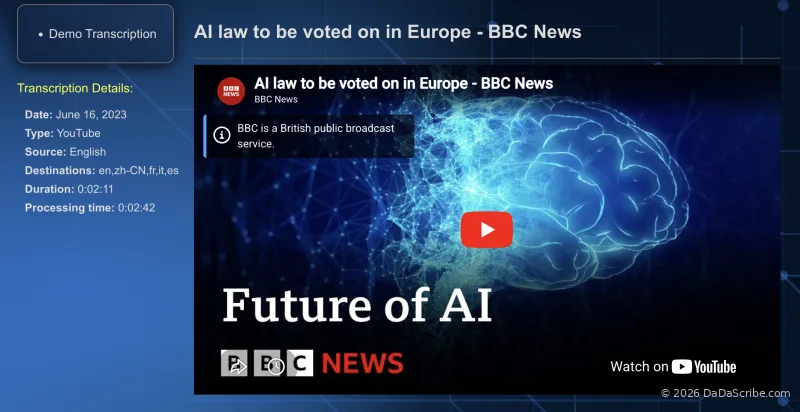
Our demo of the BBC News story "AI law to be voted on in Europe" shows the reality. The clip is 2 minutes and 11 seconds. DaDaScribe processed it in 2 minutes and 42 seconds with translations to four languages. The Elon Musk CNBC interview, 5 minutes and 22 seconds, finished in 2 minutes and 33 seconds. View both at dadascribe.com/demos/.
The transcript arrives before your coffee gets cold. The bottleneck becomes your writing speed, not your transcription speed.
What you get: a full transcript with a built-in proofreading pass. Accurate enough to pull direct quotes. Searchable text for fast fact extraction. What to watch for: names, numbers, and technical terms. AI can get these wrong on noisy recordings. Spot-check them before publishing.
When the deadline is the story, AI wins. When the story requires verified, word-perfect quotes (think defamation-sensitive investigations), allocate time for human review. The best workflow we see is AI transcript in 1 minute, then 5 minutes verifying the 3 or 4 quotes you will actually use.
Use Case 2: Press Conferences and Live Events
Multi-speaker events are where AI transcription either shines or stumbles. When the audio is clean and speakers take turns, the results are excellent. When five people talk over each other in a room with bad acoustics, no transcript is going to be clean.
The scenario: a government press conference with three officials. You need quotes attributed to the right person. You need them fast. Human transcribers charge extra for speaker labeling. AI handles it automatically.
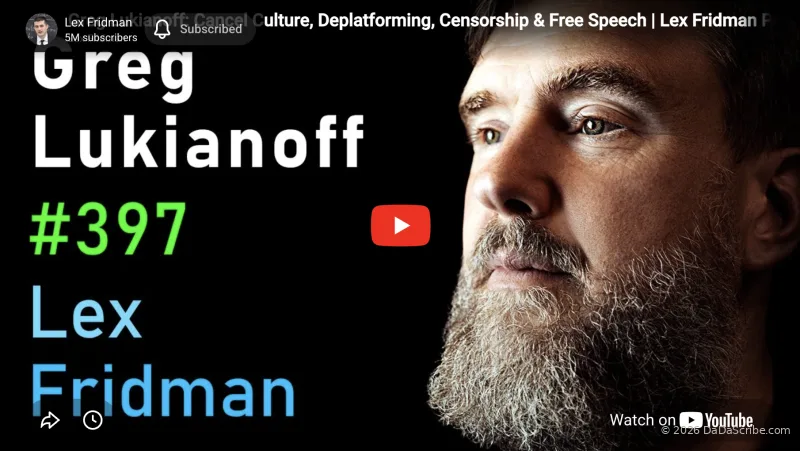
Our demo of the Lex Fridman Podcast with Greg Lukianoff shows what this looks like in practice. Two speakers. Two hours, 31 minutes, and 58 seconds of conversation. DaDaScribe processed it in 19 minutes and 39 seconds, with speaker-labeled output in English, French, Italian, Portuguese, and Spanish.
The built-in proofreading layer catches common multi-speaker errors like attributing a quote to the wrong person. Auto SRT subtitle generation means your video team gets timestamped captions without running a separate subtitling process.
Use AI for: panel discussions, press conferences, public hearings with clear audio and orderly turn-taking. Use human transcription for: events with heavy crosstalk, bad venue acoustics, or more than five speakers who frequently interrupt. AI speaker diarization degrades fast in these conditions.
Use Case 3: YouTube Source Research
This is the use case nobody talks about, and it is one of the most common requests we get. Journalists pull quotes from YouTube constantly: competitor coverage, official agency briefings, archived interviews, government channel uploads. The traditional workflow is absurd.
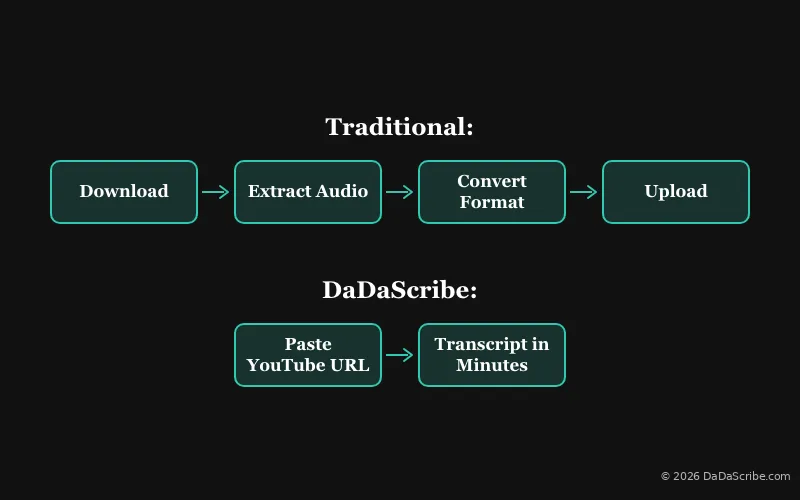
Here is what you normally do: download the YouTube video, extract the audio, convert it to a compatible format, upload it to your transcription tool, wait. Four steps, several minutes, potential quality loss at each stage.
Here is what DaDaScribe does: paste the URL. That is it. The transcript comes back with timestamps and optional SRT subtitle files. No download. No conversion. No format compatibility headaches.
If your source is on YouTube, your transcript should be one paste away. Four-step file conversion workflows belong to 2019.
Our demos show the range. The OSIRIS-REx NASA trailer, 45 seconds, processed in 1 minute and 1 second with translations to French, German, Portuguese, and Spanish. The Walter Isaacson interview on Lex Fridman, 2 hours and 7 minutes, processed in 26 minutes and 24 seconds with translations to English, Mandarin, French, Portuguese, and Spanish.
This workflow extends naturally to archival research (old footage only available on YouTube), comparative reporting (exact quotes from multiple outlets covering the same event), and press briefing archives from official channels. If it is on YouTube, you can have the text in under 2 minutes.
Use Case 4: Multi-Language International Reporting
A foreign correspondent files an interview in Arabic. The editor in London needs the quotes for an English-language piece. The video team wants French subtitles for broadcast. The social team wants Spanish captions for Instagram.
The old way: transcribe in Arabic, translate to English, translate separately to French, translate separately to Spanish, format four sets of subtitles. Each step takes hours and costs money.
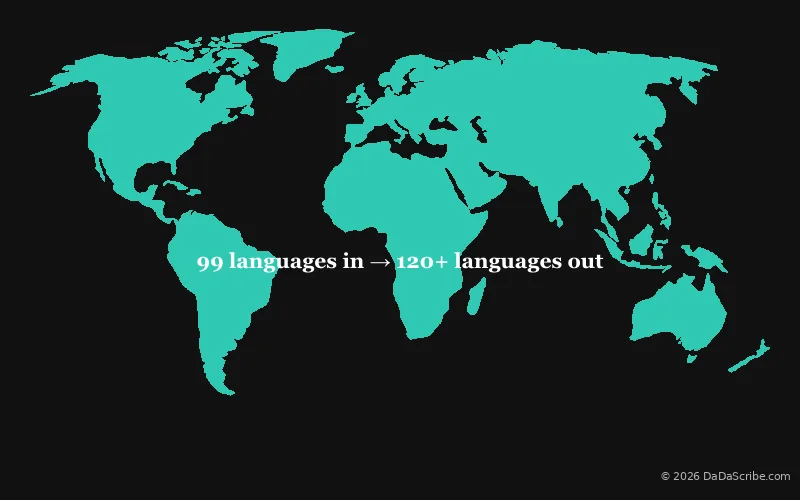
The DaDaScribe way: one upload. Transcription in the source language. Translation to any combination of 120+ languages. Auto SRT subtitle files in every target language. We support 99 input languages with consistent accuracy. The Lex Fridman demos on our site consistently output in five languages from a single English source. The Elon Musk CNBC clip processed English plus Chinese, French, Portuguese, and Spanish.
When AI translation is good enough: newsroom-internal use, gist understanding, research scanning, social media clips. When human translation is required: published quotes attributed to non-English speakers, legal or diplomatic statements, content where a mistranslation could cause real harm.
The cost difference is extreme. DaDaScribe at $0.016 per minute with translation included. Professional human transcription plus translation runs $2 to $5 per minute. A 30-minute interview in three target languages: $0.48 versus $60 to $150. For newsrooms operating on thin margins, this is not a comparison. It is a survival calculation.
Use Case 5: When Not to Use AI Transcription
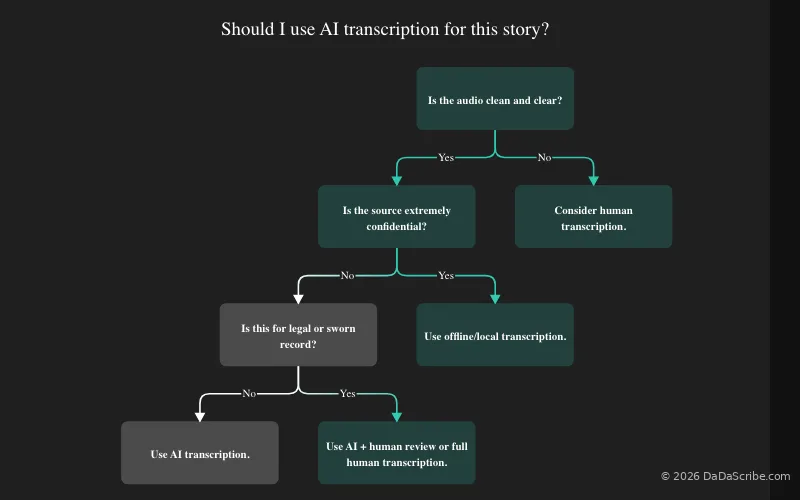
We are honest about our limits. AI transcription handles roughly 80 percent of journalist use cases reliably. The other 20 percent require human involvement. Here is how to tell which is which.
Confidential or Protected Sources
If you are working with whistleblowers, classified material, or sources who require anonymity, cloud transcription means your audio leaves your device. That creates risk. Local offline transcription (running Whisper on your own machine) or manual transcription is the safer path. Do not upload protected audio to any cloud service, including ours.
Audio with Heavy Accents, Poor Quality, or Legal Stakes
Accuracy drops on difficult audio. If the transcript could be cited in court, published as a sworn statement, or used in a defamation-sensitive story, AI plus human review is the minimum. Pure human transcription is often the right call here.
Highly Specialized Terminology
Medical, legal, or scientific content with life-or-death implications. AI transcription gets specialized vocabulary wrong often enough to matter. Human domain experts are required for verification, if not for the full transcription.
Content Where 95 Percent Accuracy Is Not Enough
For most journalism (thematic understanding, pulling quotes, summarizing), the minimum 90 percent accuracy and 95 percent average we deliver on clean audio is plenty. For verbatim transcripts intended as legal records, it is not. Know which kind of story you are working on before you decide.
AI handles 80 percent of journalist use cases. The other 20 percent need a human. Knowing which bucket your story falls into saves time and protects your reporting.
The Speed Advantage in Numbers
Here are real processing times from publicly available DaDaScribe demos. These are not estimates or best-case scenarios. They are measured results from our public demo library.
| Content | Duration | Processing Time | Languages |
|---|---|---|---|
| NASA OSIRIS-REx trailer | 0:00:45 | 0:00:26 | en + 4 |
| Beyoncé Halo (lyrics) | 0:03:45 | 0:01:36 | en |
| BBC News AI law in Europe | 0:02:11 | 0:00:55 | en + 4 |
| Elon Musk CNBC interview | 0:05:22 | 0:02:55 | en + 4 |
| Lex Fridman with Greg Lukianoff | 2:31:58 | 0:19:39 | en + 4 |
The pattern is consistent. A 45-second clip takes about half time of that. A two-and-a-half hour podcast takes under 20 minutes. Processing scales linearly. You can predict how long your file will take based on its length.
At $0.016 per minute on our Pro plan, the economics hold up at any scale. A two-and-a-half hour podcast costs $2.40. A five-minute interview costs $0.08. A full day of press conferences costs under $10. Compare that to human transcription for the same two-and-a-half hour podcast: $150 to $300. Speed matters. So does cost. For small newsrooms and freelance journalists, the difference keeps the lights on.
Pro Tips for Journalists Using AI Transcription
Record with transcription in mind. Position the microphone close to the speaker. Avoid echo-heavy rooms when you can. Cleaner audio means better transcripts. This is not subtle.
Use the YouTube URL workflow whenever the content already lives there. Your own uploads, competitors' coverage, official briefings. Skip the file handling and paste the link. It saves minutes per session, and over a year of reporting, those minutes add up to days.
Leverage multi-language output even for single-language stories. A transcript in five languages makes your reporting accessible to international audiences. It also improves your SEO reach. Both matter for publications trying to grow.
Build a searchable transcript archive. Transcribe every interview, even the ones you do not publish. Six months later, when a story resurfaces and you need that one quote from that one source, Ctrl+F in your archive beats replaying hours of audio.
Use timestamps in your video editing workflow. The auto-generated SRT files from DaDaScribe import directly into any video editing software. Editors jump to key quotes by clicking the timestamp instead of scrubbing through raw footage. A two-hour interview becomes a set of bookmarked moments.
Combine AI speed with human spot-checking. The workflow that works for published quotes: AI transcript in 1 to 2 minutes, then spend 5 minutes verifying the specific passages you will publish. You get the speed of AI and the reliability of human review, without paying for full human transcription.
Frequently Asked Questions
Can AI transcription handle multi-speaker interviews accurately?
Yes, for two to five speakers with clear audio and minimal crosstalk. Speaker labeling (diarization) runs automatically. Accuracy drops with more speakers, heavy overlapping conversation, or poor room acoustics. Panel discussions with decent audio work well. Free-for-all debates in echoey rooms do not.
Is it safe to use cloud transcription for confidential sources?
This depends on your risk tolerance and the source's requirements. Cloud transcription means audio leaves your device. For whistleblowers or legally protected sources, local offline transcription or manual transcription is safer. For standard on-record interviews with consenting sources, cloud AI transcription with a reputable provider is standard in most newsrooms.
How fast is fast enough for breaking news?
DaDaScribe processes a 30-minute press conference in roughly 1 to 2 minutes. A 5-minute interview in under 3 minutes. For breaking news deadlines measured in hours, this is more than sufficient. The faster your transcription, the sooner you start writing.
Does machine translation of transcripts work for non-English interviews?
Yes, for newsroom-internal understanding and gist extraction. DaDaScribe supports 99 input languages with translation to 120+ languages. For quotes you will publish with attribution to a non-English speaker, have a human translator verify the output. Machine translation gives you speed and coverage. Published attribution requires human confirmation.
What is the real cost difference between AI and human transcription?
DaDaScribe charges $0.016 per minute. Human transcription services range from $0.75 to $2.00 per minute. A 60-minute interview costs $0.96 with AI and $45 to $120 with a human. For a journalist filing 10 interviews per week, the annual difference is approximately $500 versus $25,000 to $60,000.
Can I transcribe a YouTube video without downloading it?
Yes. Paste the YouTube URL directly into DaDaScribe. The platform handles extraction, transcription, and optional translation server-side. No downloading, no file conversion, no format issues. The transcript and optional SRT subtitles appear in minutes.
What accuracy should I expect from AI transcription?
On clean audio (studio interviews, press conferences, good phone connections): minimum 90 percent accuracy, averaging 95 percent. On difficult audio (field recordings, heavy accents, background noise, overlapping speakers): 70 to 85 percent. For most journalistic use cases (finding quotes, understanding content, writing summaries), this is sufficient. For published, attributed quotes, spot-check the specific passages you plan to use.
We Built This for the 80 Percent
AI transcription handles the majority of what journalists need: speed, reasonable accuracy on decent audio, multi-language flexibility, and direct-from-URL convenience. Human transcription covers the rest: verification in high-stakes scenarios, protected source material, legally sensitive content, and audio too poor for any algorithm to parse.
We at DaDaScribe built the platform for the 80 percent of professionals. Fast processing (two-and-a-half-hour podcast in 38 minutes). Transparent pricing ($0.016 per minute with no hidden fees). Ninety-nine languages in, 120+ languages out. Direct YouTube URL support. Built-in proofreading. Auto SRT subtitles in every target language.
You can see the output quality for yourself before committing to anything. Upload an interview, paste a YouTube link, or browse the real demos at dadascribe.com/demos/. No credit card. No sales call. Just transcripts, at the speed your deadlines actually demand. Check our pricing plans or explore more articles in the Learning Center.
About the data: Processing times and language data in this article come from publicly available DaDaScribe demo transcriptions at dadascribe.com/demos/. Accuracy figures are drawn from DaDaScribe's internal analysis of thousands of transcriptions processed on our platform, reflecting real-world usage rather than lab benchmarks.
Comments & Questions
Please log in or sign up for a free account to leave a comment or question.
No comments yet. Be the first to ask a question!
Display more comments…